Commodity price volatility: how can mid-sized industrial companies stabilize their EBITDA?

This article has been designed as a comprehensive educational resource. Alongside the short and concise formats we also provide (Insight videos, Macroscope, and Market Insights), we have deliberately chosen a more in-depth and detailed approach in this article. Our objective is to provide you with a comprehensive understanding of the topic by exploring every nuance.
In a macroeconomic environment marked by supply shocks, geopolitical tensions and the energy transition, industrial companies face chronic instability in their procurement costs. Whether for base metals or energy, sharp fluctuations in prices on international markets can undermine the profitability of multi-year commercial contracts in just a few weeks.
For an industrial SME or mid-sized company, systematically passing on increases in input costs to the final selling price has become virtually impossible in the face of demanding customers or global competitors. Protecting industrial margins and stabilizing EBITDA are no longer simply a matter of commercial negotiation, but require strict financial and operational management.
Yet a common mistake persists: managing rising commodity prices and foreign exchange risk separately. As most global commodities are priced in US dollars (USD), volatility in the underlying commodity price and the currency can compound or offset each other in an uncontrolled manner.
To safeguard their margins over the long term, mid-sized industrial companies must adopt a comprehensive approach: an integrated hedging strategy (Commodity + FX).
1. The cross-risk trap: when currency movements offset gains on raw materials
For most industrial SMEs and mid-sized companies (metal processing, plastics, food processing, packaging), raw materials often represent the largest component of a finished product's cost, although their share varies significantly across sectors.
When a company purchases aluminium, copper or natural gas, it is exposed to simultaneous market risks:
- Commodity price risk (Commodity Risk): Fluctuations in the benchmark index on organised markets such as the London Metal Exchange (LME) or the Intercontinental Exchange (ICE). However, the price is rarely based on the standard contract alone: the pricing formula most often includes a physical premium, a quality, location or delivery differential, and an averaging period.
- Basis risk (Basis Risk): This arises from the difference between the price actually paid and the reference contract used for hedging. This risk stems from regional premiums (for example, the delivery premium on aluminium or copper), the quality and form of the product, the delivery point (a gas hub different from the one underlying the futures contract) and the mismatch between the contract's maturity and the actual price-fixing date. A hedge using the standard contract therefore neutralises only part of the exposure.
- Foreign exchange risk (FX Risk): Most of these global indices are denominated in US dollars (USD), while the operating costs and revenues of European companies are predominantly expressed in euros (EUR).
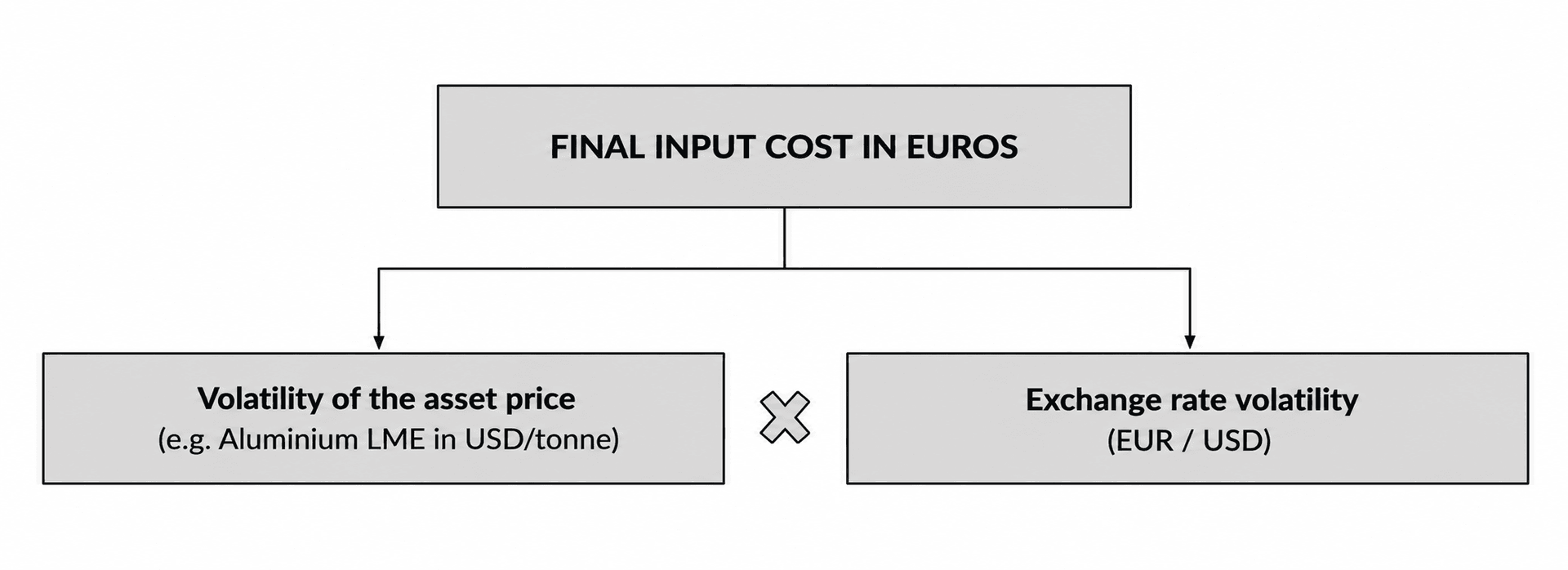
The scissors effect: illustration of a failed standalone hedge
Consider a French mid-sized company, a manufacturer of electrical cables, whose copper purchase contract is indexed to the LME, quoted in dollars, but invoiced in euros.
- The price of copper falls by 8% on the LME: from USD 9,000 to USD 8,280 per tonne.
- Over the same period, the euro loses 10% against the dollar: EUR/USD moves from 1.10 to 0.99.
- Result in euros: the price per tonne rises from approximately €8,180 to approximately €8,360, an increase of 2.2%.
Hedging the metal without hedging the dollar (or vice versa) is like leaving the door half open. An effective commodity hedging strategy must neutralise both variables within the same calculation matrix.
2. The integrated approach: coordinating commodity and FX hedging, and breaking down barriers between teams
Integrating foreign exchange and commodity risk involves designing synchronised hedging structures at the precise moment when a purchase commitment is made or a budget forecast is established.
Why move away from management in "Silos"?
In the traditional organisation of large SMEs and mid-sized companies, the purchasing department manages supplier contracts and sometimes attempts to fix metal prices with traders, while the finance department independently manages cash flow and foreign exchange.
This separation creates major operational issues:
- Over-hedging or under-hedging: The volumes of currency purchased forward do not exactly match the payment dates of gas or metal invoices.
- Inconsistency in budget rates: The cost price calculated by management control based on an aluminium price in USD becomes unrealistic if the budgeted EUR/USD exchange rate is exceeded.
- Lack of coordination: Timing mismatches between commodity price hedges and currency hedges, creating the risk of a double adverse effect.
- Unnecessary use of hedging credit lines and increased risk of margin calls or collateral requirements: Managing price risk and foreign exchange risk separately, with different counterparties, uses up more credit limits and, where applicable, collateral, even though certain positions could offset each other or be structured together.
An example to illustrate the first point: The purchasing department negotiates invoicing in euros rather than dollars with a supplier to "eliminate" foreign exchange risk. This is a positive commercial outcome. However, if the treasury department has already hedged the USD exposure, it now holds an FX forward without an underlying exposure. Furthermore, if the supplier operates and accounts for its business in USD, it will adjust the euro prices of its products according to the EUR/USD exchange rate, thereby maintaining the buyer's foreign exchange risk, without the buyer being able to manage it through hedging instruments due to the absence of an identified contractual or accounting underlying exposure.
3. The range of hedging instruments: forwards, swaps, options and bespoke structures
- Hedging gold, aluminium and copper: swaps and average-price options
- Hedging natural gas or Brent crude oil: swaps, options and delivery profiles
- Hedging the associated foreign exchange risk
Depending on their cost structure and the possibilities for indexing customer contracts, finance departments have several market instruments at their disposal to design their hedging policy for these inputs.
A. Commodity swaps (Fixed-for-Floating)
The swap is the basic instrument of industrial hedging. It allows a variable price (the spot price of the underlying commodity on the LME or PEG/TTF for gas) to be exchanged for a guaranteed fixed price over a given period (e.g. 12 rolling months).
- FX Combinaison : The USD-denominated commodity swap is simultaneously paired with an FX forward (EUR/USD Forward) of the same maturity and notional amount, definitively locking in the cost price in euros per tonne or per MWh.
B. Option structures (Tunnels and Call/Collar)
For companies seeking protection against rising prices while retaining the ability to benefit from falling market prices, implementing a call (price cap linked to a call option) or a Collar (zero-premium or with a residual premium) is ideal.
- Application : A mid-sized company consuming gas sets a maximum purchase price on the PEG. If gas prices surge, the bank compensates for the increase. If gas prices fall below the floor, the company pays the floor price. Combined with an EUR/USD FX collar, the industrial gross margin is fully protected within a budgeted range.
C. Combined instruments (Cross-Commodity / Quantos)
For mid-sized companies with advanced financial expertise, complex options (Quanto or Dual Strike options) are available, allowing both the underlying commodity AND the foreign exchange risk to be hedged within a single contract, thereby reducing the overall cost of premiums by exploiting the statistical correlation between the currency and the commodity.
Hedging Instrument | Budgetary Objective | Management of Associated FX Risk | Level of Flexibility |
Swap Forward | Fixing 100% of the cost price in USD. | Forward sale of EUR / Purchase of USD, synchronised (Forward). | None (Firm commitment, no benefit from price decreases). |
Call Option Purchase (Cap) | Guaranteed maximum price in USD, with the ability to benefit from price decreases. | Call option (USD Call) or spot purchase at maturity. | Maximum (Paid for through an upfront premium). |
Tunnel / Collar | Keeping the price within a range (Floor / Cap). | EUR/USD FX collar aligned with the metal price boundaries. | Intermediate (Zero-premium structure). |
Integrated Contract (Cross-Risk) | Simultaneously securing the commodity price in EUR. | Natively integrated into the derivative's settlement formula. | Optimised, but beware of bank margins and lack of flexibility (Reduction in overall volatility). |
4. From theory to practice: IFRS 9 alignment and the role of an outsourced trading desk
Implementing an integrated commodity hedging strategy requires SMEs and mid-sized companies to overcome two major obstacles: accounting complexity and access to financial markets.
Qualification under IFRS 9 (Hedge accounting)
To prevent the market value (Mark-to-Market) of metal or energy derivatives from impacting the income statement at each quarterly closing, the company must apply the rules of cash flow hedge accounting (Cash Flow Hedge).
Integrating foreign exchange and commodity risk requires precise documentation of the effectiveness of the relationship between the forecast physical purchase of aluminium/copper and the underlying derivative contracts, otherwise the hedge accounting relationship may be disqualified by the statutory auditors.
Obtaining competitive hedging terms, without conflicts of interest
For commodity and foreign exchange derivatives, price differences between counterparties can be significant, and SMEs and mid-sized companies rarely have the tools to measure them. An independent adviser, who does not sell products or earn margins on transactions, can help to:
- Establish objective pricing: obtain an independent market reference (prices, forward curves, volatilities) to measure the margin embedded in the quotes received.
- Organise competitive bidding: select counterparties, structure requests for quotations and compare offers on a consistent basis, including when commodity and foreign exchange hedges are managed together.
- Manage documentation and collateral: analyse the terms of ISDA/CSA agreements (thresholds, margin calls, eligible currencies) and identify points to negotiate with banks to preserve liquidity.
Execution remains the responsibility of the company, through its banks or brokers.
When financial hedging is not accessible
Not all markets can be hedged. For certain materials, such as many polymers and engineering plastics, derivatives markets are non-existent, highly illiquid or inaccessible to smaller SMEs due to volumes, minimum contract sizes and the limited number of counterparties. Benchmark indices exist, but instruments to hedge against their fluctuations are scarce.
In this case, protection relies on operational measures:
- Supplier negotiations: indexation clauses (choice of index, revision frequency, averaging period), price caps and floors, fixed-price contracts over a given period, sharing price increases and decreases.
- Inventory strategy: building up stocks when prices are low, at the cost of financing, storage and the risk of obsolescence.
- Diversification : increasing the number of supply sources, qualifying substitute materials and spreading purchases over time.
- Passing costs on to selling prices: indexation clauses with customers to transfer all or part of the price variation.
A substitute hedge (proxy hedge) using a correlated commodity, such as oil or naphtha, may sometimes be considered, but it leaves significant basis risk, as the correlation is not stable. It is only justified if this correlation is measured and documented.
Conclusion: Protecting industrial margins as a strategic lever
Faced with structural volatility in global markets, stabilising the EBITDA of an industrial SME or mid-sized company can no longer be left to chance. By combining input hedging (metals, energy) with dynamic management of USD foreign exchange risk, finance departments turn a source of vulnerability into a sustainable competitive advantage.
An integrated hedging strategy does not aim to speculate on market prices, but rather to secure the cost price necessary for the company's long-term viability, enable it to neutralise temporary shocks, and give it time to adapt to lasting disruptions.
At Kerius Finance, we support industrial companies in modelling their cross-market risks (Commodities + Forex), structuring their hedging policies and negotiating the best execution terms on international markets.
Assess your margins' sensitivity to commodity prices and currencies
Are your metal or energy procurement costs putting pressure on your EBITDA?
Meet our market risk experts to carry out an integrated hedging simulation tailored to your industrial budget.
Disclaimer:
Kerius Finance SAS is an independent advisory firm, registered as a Financial Investment Adviser (CIF) – ORIAS No. 13000716 – Member of ANACOFI-CIF, an association approved by the French Financial Markets Authority (AMF).
As such, Kerius Finance, which is independent of financial products and banks and does not distribute or sell any financial products, only provides personalised recommendations after signing an engagement letter specifying the client's objectives and conducting in-depth, tailored analyses.
This document is therefore published for informational and educational purposes only. It does not, under any circumstances, constitute a recommendation to trade any of the products described. The Kerius Finance teams remain available to anyone seeking further information or personalised advice, in order to offer services tailored to their specific needs.
Please note: banks may offer products that appear identical but include specific, sometimes subtle clauses that alter the product's outcome and accounting treatment. These products may therefore differ from those presented here, even if their names are identical or very similar. Banks also offer "enhanced" or "dynamic" products. Such products must be handled with great caution and require prior analysis of their potential outcomes.
In any case, we recommend that companies without an expert treasurer and professional valuation systems seek advice from qualified, authorised advisers to carry out the appropriate analyses and select the right strategy without conflicts of interest, before negotiating the best possible terms (legal provisions and pricing) with their usual banks. It is also often useful to monitor the strategy over time to ensure that any event affecting the debt does not require an adjustment to the hedge.

OUR TEAM SUPPORTS YOU
Kerius Finance brings together a team of passionate experts dedicated to analyzing, managing, and optimizing financial risks. Our approach is based on transparency, rigor, and attentiveness, enabling us to fully understand your challenges and provide tailored solutions.