Hedge Accounting: optimize your IFRS reports (9, 13, 16) without burdening your processes
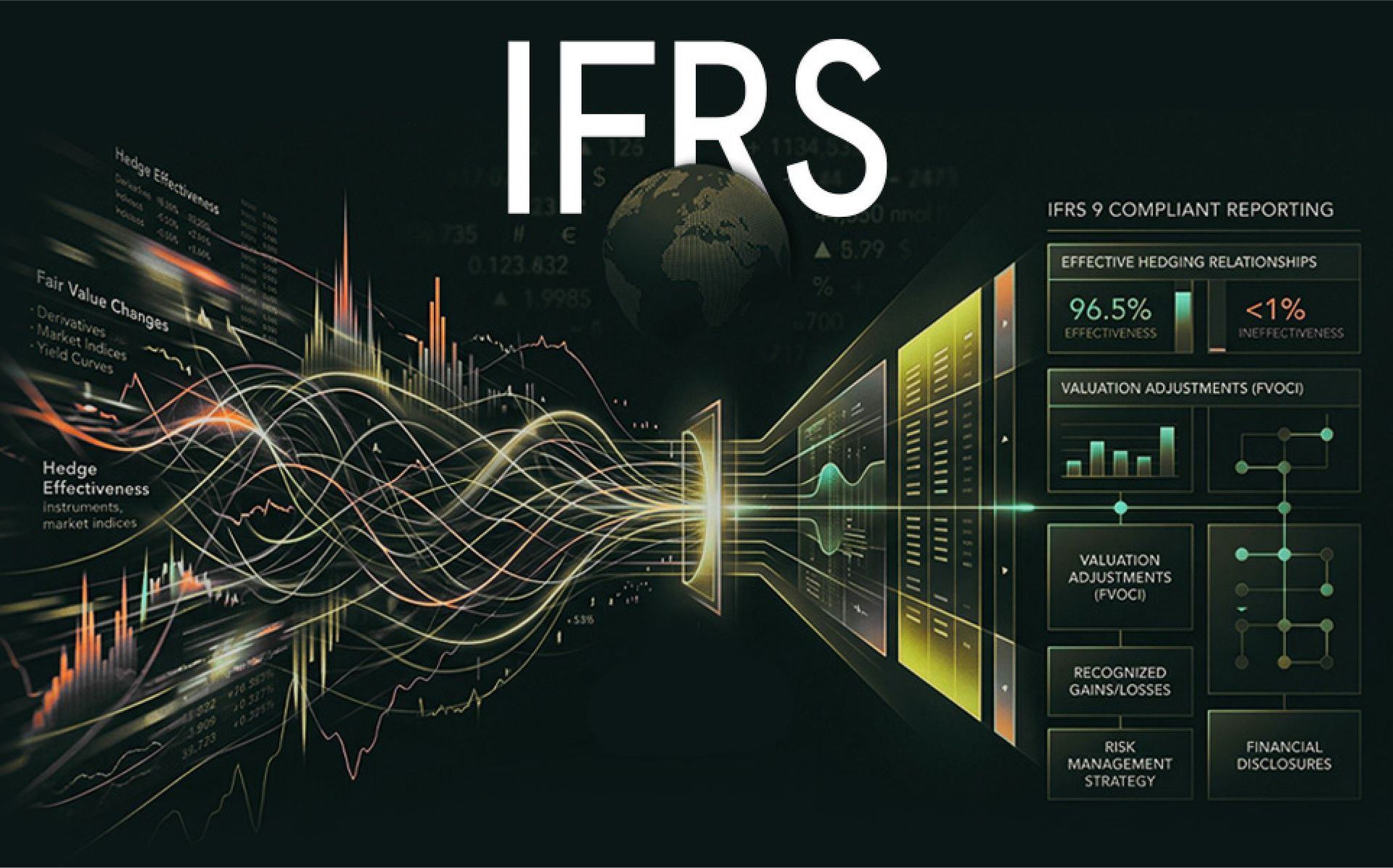
This article was designed as an in-depth educational resource. Alongside the short and concise formats we also offer (Insight videos, Macroscope, Décryptages), we chose in this article to prioritize density and detailed explanations. The goal is to provide you with a comprehensive understanding of the subject, exploring every nuance.
Hedge accounting is often perceived as a bureaucratic nightmare: documentation, tests, derivative valuation, restatements in OCI or P&L, ineffectiveness tracking… Many companies end up giving up, even when they use perfectly legitimate hedging instruments from a risk management perspective and the subject can be handled without unnecessary burden.
The problem is not hedging itself. The problem is producing reliable (audit-proof) IFRS 9 reporting without creating a disproportionate operational burden.
This article explains:
- why reporting is complex (and what really matters),
- how the valuation of derivative instruments is structured under IFRS,
- the concrete impact on the balance sheet and income statement,
- and how to choose between micro vs macro hedging, depending on your organization and objectives.
Mini-glossary (for non-expert readers)
- Derivative instrument: financial contract whose value depends on an underlying asset (rates, FX, commodities). E.g.: swap, option, forward.
- Fair value: estimated exit price to sell an asset or transfer a liability at the valuation date. For a derivative, it represents its market value or modelled value. Under IFRS, derivatives are mandatorily marked to fair value on the balance sheet at each closing, with variations impacting profit or loss or equity (OCI) depending on the hedging method.
- OCI (Other Comprehensive Income): certain fair value variations can be recorded in OCI rather than in P&L, depending on the type of hedge.
- Cash-flow hedge: hedge of the variability of future cash flows (e.g.: variable rate debt or forecast USD invoicing). Part of the derivative's value changes may go to OCI.
- Fair value hedge: hedge of the fair value variation of an item (e.g.: fixed rate debt hedged against a rate rise/fall or USD invoicing already issued and recorded on the balance sheet). Impacts generally in P&L (derivative and hedged item).
- Ineffectiveness: the portion of the hedge that does not perfectly offset the hedged item. IFRS 9 frames the concept and requires monitoring.
1) Why hedge accounting IFRS 9 seems "complex" (and what really makes the difference)
Under IFRS 9, the ambition is to better align accounting with risk management… but it remains demanding. For a hedging relationship to "hold" in audit, the key requirements are:
- a clear designation (which underlying risk is hedged? over what scope and horizon?),
- documentation at inception and on an ongoing basis,
- a consistent method to measure and explain effectiveness / ineffectiveness,
- and a robust, traceable valuation of derivatives.
The most costly part is not the "accounting entry". It is the ability to produce, month after month, a file that answers two simple questions:
- “Does the strategy reflect the risk management and the hedging policy validated by governance?”
- “Are the figures traceable, recalculable, and consistent with the market?”
IFRS 9 defines the concepts of effectiveness/ineffectiveness and the obligations at designation and on an ongoing basis.
2) Derivative instrument valuation under IFRS: what your reporting must make readable
Valuation is not a "trading floor" subject reserved for banks. Under IFRS, it is a central point because:
- the derivative appears on the balance sheet at fair value;
- the fair value variation impacts either P&L (EBIT / operating income or financial result depending on the underlying), or OCI, depending on the type of hedge accounting.
The expected reporting must clarify, without unnecessary jargon:
- the valuation logic (curves, discounting, volatility for options),
- key parameters and their source (market),
- and sensitivity to market movements.
Good practice: produce a one-page "auditor summary":
- types of derivatives in portfolio,
- valuation methods,
- consistency controls (reconciliations, variances, alert thresholds),
- and explanation of significant variations.
3) Impact on balance sheet and income statement: what the CFO wants to understand in 2 minutes
Case 1 - Cash-flow hedge (e.g.: variable rate debt or forecast invoicing in non-functional currency)
Objective: smooth the impact of interest rate (or FX) variability on future cash flows.
Under IFRS 9, part of the derivative's value changes may go to OCI (hedging reserve) then be "reclassified" to financial or operating income when the hedged underlying flow affects P&L.
Point of attention: ineffectiveness (the uncompensated portion) must be identified and treated according to applicable rules.
Case 2 - Fair value hedge (e.g.: fixed rate debt or issued currency invoicing)
Objective: neutralize the value variation of the hedged item and the derivative.
Here, the mechanics are often more "P&L visible": you will see symmetrical effects (derivative + hedged underlying) that can be surprising if the reporting does not clearly explain the logic.
What reporting must absolutely avoid
- unexplained P&L/OCI impacts (even if technically correct),
- valuation variations not linked to market drivers,
- method breaks (source of qualification in audit).
4) Micro vs macro hedging: differences, choices and accounting impacts
Micro hedging: "contract by contract"
Micro hedging designates an identified hedged underlying (or a group) and a dedicated hedging relationship.
When it is appropriate
- simple and traceable exposure (one debt, one flow, one identified risk),
- very limited portfolio size and non-evolving underlying (simple debt that does not evolve over time-no refinancing, no additional debt such as factoring or supplementary tranches) or future invoicing in currencies significant enough to hedge individually and without uncertainty over realisation (example: large USD contract with a few clearly identified invoices and no risk of cancellation or substitution),need for fine control and straightforward audit trail.
Impacts
- simpler documentation,
- but operational burden that increases with the number of hedging relationships and inability to maintain hedge accounting if the underlying evolves or is replaced by a similar underlying (even within an amend & extend in a debt restructuring framework).
Macro hedging: "portfolio"
Macro hedging addresses a reality: many companies manage risk (particularly interest rate risk) at portfolio level, not instrument by instrument.
Yet, the IASB recognises that dynamic risk management at portfolio level is difficult to reflect with current models, hence the “Dynamic Risk Management / macro hedging”.
When it is relevant
- large portfolio of debts/assets, "global" strategy,
- need to manage interest rate risk dynamically and to have a global hedging approach for a portfolio of underlying risks (multiple and evolving debts, multiple and unidentified client invoicings or not treated individually),
- desire to limit the number of micro relationships.
Impacts
- greater modelling and governance complexity,
- frequent discussions around the alignment between risk management and accounting rules,
- "high-level" subject that must be framed early (audit committee, CFO, treasury, audit, advisors).
5) "Optimise without burdening": a pragmatic method in 6 building blocks
1) Start from management decisions, not accounting entries
Define first:
- risks hedged (interest rates, FX, commodities): amounts, horizons, risk of exposure variation over time,
- objectives targeted (P&L stability, cash stability, covenant protection),
- horizon and target hedge ratio.
2) Standardise documentation (templates)
A good template drastically reduces the burden:
- designation, hedged underlying, instrument, valuation method,
- market data sources,
- stop / rebalancing criteria.
3) Choose a "core" set of valuation methods
Avoid 10 methods for 10 products if not strictly necessary (it rarely is!). Consistency and traceability take priority.
4) Automate controls that save time
- reconciliations (notionals, dates, indices),
- valuation variance thresholds,
- OCI/P&L reconciliation.
5) Produce two-level reporting
- Level 1 (management): drivers, impacts, decisions.
- Level 2 (audit trail): details, calculations, market evidence, supporting documents.
6) Organise role separation (even lightly)
Even in an SME/mid-cap, task separation is necessary:
- policy validation: shareholders / audit committee,
- practical decisions (treasury/CFO),
- execution (bank/counterparty),
- control & reporting (back-office / finance).
Would you like robust IFRS 9 hedge accounting without complicating your organisation?
Kerius Finance supports you on : hedging strategy definition upstream of documentation, scoping (micro vs macro), documentation, valuations, front/middle/back governance, and implementation of readable IFRS 9 reporting (management + audit trail).
👉 Contact us for a diagnostic (scope, exposure, possible automation level) and a simplification plan.
FAQ - Hedge Accounting IFRS 9
1) What is IFRS 9 hedge accounting?
Hedge accounting is an accounting treatment that aims to reduce artificial result volatility by aligning accounting with risk management (rates, FX, commodities). IFRS 9 strictly governs designation, documentation, measurement of effectiveness/ineffectiveness and the way fair value variations flow through P&L or OCI.
2) Why is IFRS derivative valuation a critical point?
Because derivatives are generally recognised at fair value on the balance sheet. The variation of this fair value can impact the income statement or OCI depending on the type of hedge. Robust reporting must explain the main drivers (rate curves, discounting, volatility for options) and be traceable and recalculable in audit.
3) What is the difference between a cash-flow hedge and a fair value hedge?
- Cash-flow hedge : covers the variability of future flows (e.g. interest on variable rate debt). Part of the derivative's value variation is generally recorded in OCI, then reclassified to profit or loss when the hedged flow affects P&L.
- Fair value hedge : covers the fair value variation of an item (e.g. fixed rate debt). Fair value variations of both the derivative and the hedged item generally impact P&L, which can make the reading of results more "noisy" if reporting does not explain the symmetry.
4) What is ineffectiveness in hedge accounting?
Ineffectiveness is the portion of the derivative's value variation that does not perfectly offset the hedged item. IFRS 9 requires it to be identified and recognised according to applicable rules, which requires a consistent (and documented) method of measurement and explanation.
5) Micro vs macro hedging: how to choose?
- Micro hedging : identified hedging relationship "contract by contract" (or group), suitable when exposures are simple, traceable and few in number.
- Macro hedging : portfolio logic, relevant when the company manages risk at a global level and wants to avoid an explosion in the number of micro relationships. Dynamic risk management at portfolio level is a recognised complex subject, with dedicated IASB workstreams (Dynamic Risk Management).
6) What are the minimum deliverables of IFRS 9 debt financial reporting?
An "audit-proof" IFRS 9 reporting generally includes:
- derivative inventory (type, notionals, maturities, underlyings)
- valuation method and assumptions (market sources, parameters)
- fair value movements (P&L / OCI) and explanation of drivers
- prospective and retrospective effectiveness/ineffectiveness tests and reconciliations (the prospective test validates the hedging relationship and the retrospective test quantifies potential ineffectiveness and adjustments to be recorded in the hedging relationship through P&L)
- hedge documentation (designation, objective, strategy, thresholds, governance).
7) How to simplify hedge accounting without losing compliance?
The most effective levers are:
- standardise documentation (templates)
- limit the number of valuation methods (consistency)
- automate consistency controls (notionals, dates, indices, reconciliations)
- produce two-level reporting: management (drivers/impacts) + audit trail (evidence/calculations).
8) When is it better not to apply hedge accounting?
When the company cannot guarantee documentation discipline, the ability to produce traceable valuations, and a minimum of control/back-office. In this case, it is sometimes better to have a well-managed economic hedge than a fragile hedge accounting that "breaks" in audit. However, in this case, hedge gains and losses will necessarily be recorded in financial result on an ongoing basis and not in operating or financial result simultaneously with the hedged underlying. The reading and understanding of financial statements may be disrupted as a result.
Disclaimer:
Kerius Finance is an independent advisory firm, authorised as a Financial Investment Advisor (CIF) – ORIAS No. 13000716 – Member of ANACOFI-CIF, an association approved by the Autorité des Marchés Financiers (France).
As such, Kerius Finance, which is product- and bank-neutral and does not distribute or sell any financial products, only provides personalised recommendations after signing an engagement letter specifying the client's objectives, and carrying out in-depth, personalised analyses.
This document is therefore published for informational and educational purposes only. It does not constitute under any circumstances a recommendation to enter into any of the products described. The Kerius Finance teams are available to anyone who would like further clarification or needs personalised advice, to offer them specific services.
Please note: banks may offer products that appear identical but include specific clauses, sometimes subtle, that change the outcome of the product and its accounting treatment, and may differ from the products presented even though their name may be identical or very similar. They also offer "enhanced" or "dynamic" products. These products should be handled with great caution and require prior performance analyses.
We recommend in any case that companies which do not have access to an expert treasurer and professional valuation systems seek the support of qualified, regulated advisors to carry out the appropriate analyses, select the right strategy without conflicts of interest, and then negotiate it as effectively as possible (legal terms and pricing) with their usual banking partners. It is also often useful to monitor the strategy over time to ensure that any developments affecting the debt do not require adjustments to the hedging strategy.

OUR TEAM SUPPORTS YOU
Kerius Finance brings together a team of passionate experts dedicated to analyzing, managing, and optimizing financial risks. Our approach is based on transparency, rigor, and attentiveness, enabling us to fully understand your challenges and provide tailored solutions.