Transparency of margins in 2026: Outsourced trading desk vs direct bank execution, what benefit for companies?
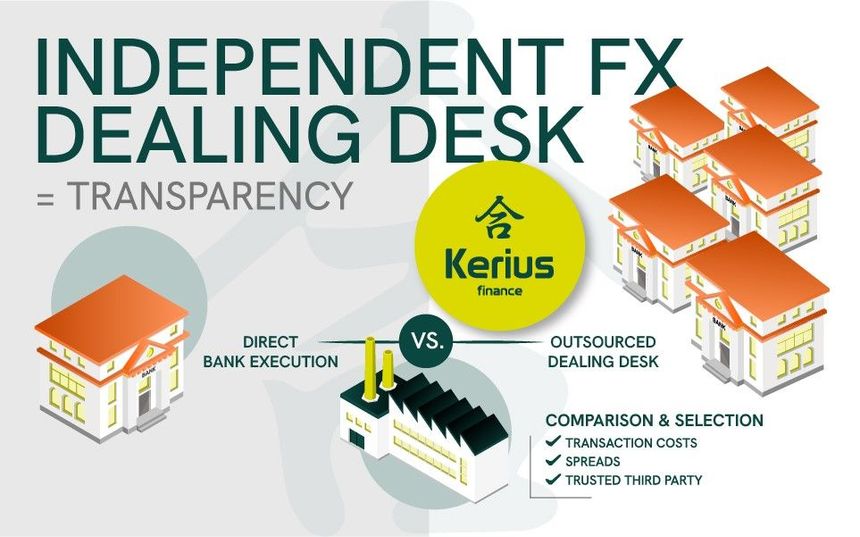
This article has been designed as a comprehensive educational resource. Alongside the short and concise formats we also provide (Insight videos, Macroscope, and Market Insights), we have deliberately chosen a more in-depth and detailed approach in this article. Our objective is to provide you with a comprehensive understanding of the topic by exploring every nuance.
In an increasingly sophisticated market environment in 2026, financial risk management (interest rates and foreign exchange) has become a matter of survival for companies’ margins. Yet, a paradox remains: while finance departments demand extreme granularity regarding their industrial costs, the execution of their financial hedging strategies often remains a grey area.
Historically tied to the traditional banking model, more and more finance departments are now moving away from direct execution with their transaction banks and turning to an independent model: outsourcing the trading desk.
Why this structural transition? Beyond the simple pursuit of competitiveness, it reflects an absolute determination to break down information asymmetry and regain control over operational execution. An analysis of a paradigm shift.
1. The traditional banking model: the illusion of free services and margin opacity
When a company executes a hedging transaction (Forward, Swap, Options) directly with its financing bank, it is dealing with a seller whose legitimate objective is to maximise the profitability of the transaction (the P&L of the bank’s trading desk).
In most cases, there is no explicit invoicing in the form of fees. The bank is remunerated through the spread, meaning the difference between the actual interbank market rate (Mid-market), which is a non-tradable rate, and the final rate applied to the company.
Without real-time access to professional terminals (Bloomberg, Reuters) and without the technical expertise required to calculate implied volatilities or swap points to the nearest second, the CFO or treasurer negotiates blindly.This structural information asymmetry systematically benefits the bank. The lack of transparency regarding the margins applied to customised OTC products therefore turns financial execution into a hidden cost centre, weighing heavily on the company’s overall competitiveness.
2. The outsourced trading desk: a trusted third party serving companies
In light of this situation, outsourcing the trading desk has emerged as the optimal governance solution. The approach consists of appointing a firm of independent experts, equipped with the same technological infrastructure as a bank, to act as an extension of the company’s finance department and restore information symmetry.
The independent adviser does not take positions on its own account, does not trade on behalf of its client unless it has been given a mandate to do so, and is not remunerated based on transaction volumes. Its role as a trusted third party rests on three pillars:
- Pricing transparency (Best Execution): Transactions are reviewed with real-time visibility of interbank market rates. The spread charged by financial counterparties is isolated, explained, negotiated and brought back to best market practice.
- Institutional access: Thanks to the overall volume handled by the trusted third party on behalf of all its clients, an SME or mid-sized company gains access to prices similar to those available to a company with an internal trading desk, a privilege traditionally reserved for major CAC40 groups.
- Operational security: Beyond price, execution reliability takes precedence. The trusted third party ensures that the transaction is perfectly aligned with the hedging policy or the risk that the company is seeking to hedge ) and verifies the accuracy of the valuations (Mark-to-Market) provided by the counterparties.
3. Strategic comparison: Direct bank execution vs Outsourcing
This table summarises the structural differences between the traditional model and the independent approach in 2026.
Analysis criteria | Direct Bank Execution (Traditional Model) | Outsourced Trading Desk (Independent Model) |
| Alignment of interests | Divergent: the bank maximises its margin on each transaction with the client. | Total: the independent adviser protects the company’s margin, without any conflict of interest. |
| Spread transparency | Opacity: margin hidden in the final execution rate. Difficult for the company to audit, including retrospectively. | Total: clear separation between the pure interbank rate (Mid-market) and the negotiated bank margin, which may itself have several components (trading costs, regulatory costs, risk remuneration and commercial margin) that must be understood in order to optimise it. |
| Information asymmetry | High: the company does not have access to real-time institutional pricing screens. | None: the trusted third party provides the details and pricing calculations and restores market balance. |
| Overall execution cost | High: linked to the credit risk perceived by the bank and the absence of instant competition. And instant competition is often impossible for technical reasons or because the bank only prepares the regulatory and contractual documentation after being selected. | Optimised: the company gains access to prices similar to those available to a company with an in-house trading desk because the process is broken down and handled using the same tools and practices as banks. The margin agreed during a prior tender process may be retained when the transaction is executed several days or weeks later (a common bank timeframe for documenting structured finance hedges). |
| Execution reliability and Advice | Flow execution. Advice is often standardised or biased towards the structured products that are most profitable for the bank. | Tailored. Absolute execution reliability, aligned with risk modelling (LBOs, infrastructure, etc.). |
| Governance, EMIR and IFRS 9 | Depending on the counterparty’s market classification, whether it is financial or non-financial, below or above the materiality thresholds, the bank may handle the delegation of reporting to trade repositories and provide the client with the valuation of the positions | The trusted third party reconciles and may integrate the production of valuations. It may also provide documentation and reporting to enable the application of the special accounting treatment under Hedge Accounting. |
4. The real benefits for the Finance Department
Opting for an outsourced trading desk goes beyond the simple optimisation of transaction costs. It is an act of strategic restructuring that offers CFOs and Treasurers multiple advantages:
- Time and efficiency gains: Internal teams are freed from time-consuming market monitoring, competitive telephone tendering between bank trading desks and the tedious review of framework documentation and final confirmations (Middle/Back Office).
- Neutrality and independence: The choice of hedging instruments (vanilla vs structured) is dictated solely by the protection of the company’s balance sheet, without being subject to commercial pressure from a partner bank which, in any event, does not have all of its client’s operational information.
- Preservation of the banking pool: Entrusting execution to a trusted third party does not damage the banking relationship. On the contrary, it improves it by clarifying the rules of the game and accelerating tender processes. The financing banks remain the final counterparties, but they now operate within a transparent competitive framework that is technically controlled by the company.
Conclusion: Regaining control over financial execution
In 2026, technological developments and governance requirements no longer allow financial hedging transactions to be conducted "blindly". Demanding margin transparency and breaking down information asymmetry are prerequisites for protecting the performance of an SME or mid-sized company.
By relying on the outsourcing of the trading desk, finance departments equip themselves with the same institutional firepower as banking players, ensuring complete integrity in the implementation of their strategies.
Kerius Finance positions itself as your outsourced trading desk software platform. We defend your interests when dealing with banking counterparties with one absolute requirement: transparency, expertise and performance in the choice of strategy and its negotiation (legal and regulatory documentation and product pricing)..
Assess the competitiveness of your financial executions
Are you certain that you are obtaining the best execution for your market transactions?
Conduct a confidential audit of your historical spreads with Kerius Finance’s independent experts.
Please feel free to contact us to discuss your requirements.

OUR TEAM SUPPORTS YOU
Kerius Finance brings together a team of passionate experts dedicated to analyzing, managing, and optimizing financial risks. Our approach is based on transparency, rigor, and attentiveness, enabling us to fully understand your challenges and provide tailored solutions.