Fund-level hedging: Securing commitments and distributions against currency volatility
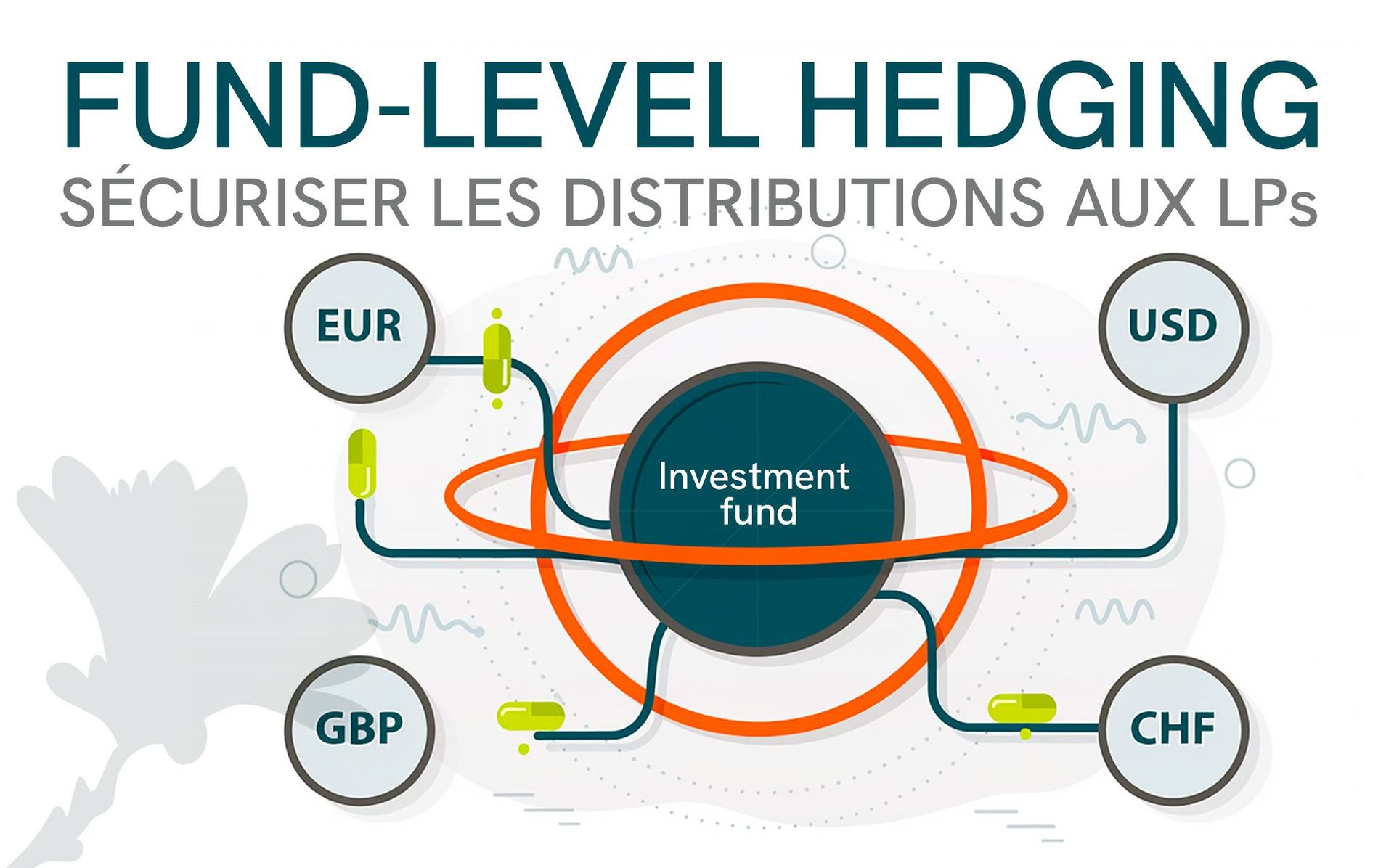
This article has been designed as a comprehensive educational resource. Alongside the short and concise formats we also provide (Insight videos, Macroscope, and Market Insights), we have deliberately chosen a more in-depth and detailed approach in this article. Our objective is to provide you with a comprehensive understanding of the topic by exploring every nuance.
In the world of Private Equity, infrastructure, and real estate, the pursuit of performance no longer stops at currency borders. To attract international capital, General Partners (GPs) are increasingly structuring multi-currency investment vehicles. However, this internationalization inevitably exposes funds to a major source of friction: foreign exchange market volatility.
When a fund raises capital in USD, invests in EUR, and distributes its final performance in GBP, movements in the foreign exchange market can turn an excellent underlying operational performance into a financial disappointment for investors (Limited Partners, or LPs).
This is where fund-level hedging comes into play. Unlike portfolio-level hedging, which directly protects portfolio holdings on the balance sheet, fund-level risk management aims to neutralize foreign exchange mismatches between feeder structures, the master fund, and capital call and distribution cash flows.
This guide examines the complex mechanics, regulatory framework, and reporting requirements that are essential for mastering GP LP FX risk management.
1. Master-Feeder structures and currency mismatches
To accommodate LPs with different base currencies, structuring funds through mirror entities or nested compartments has become the market standard. The most common setup remains the Master-Feeder structure (Master Fund / Feeder Fund).
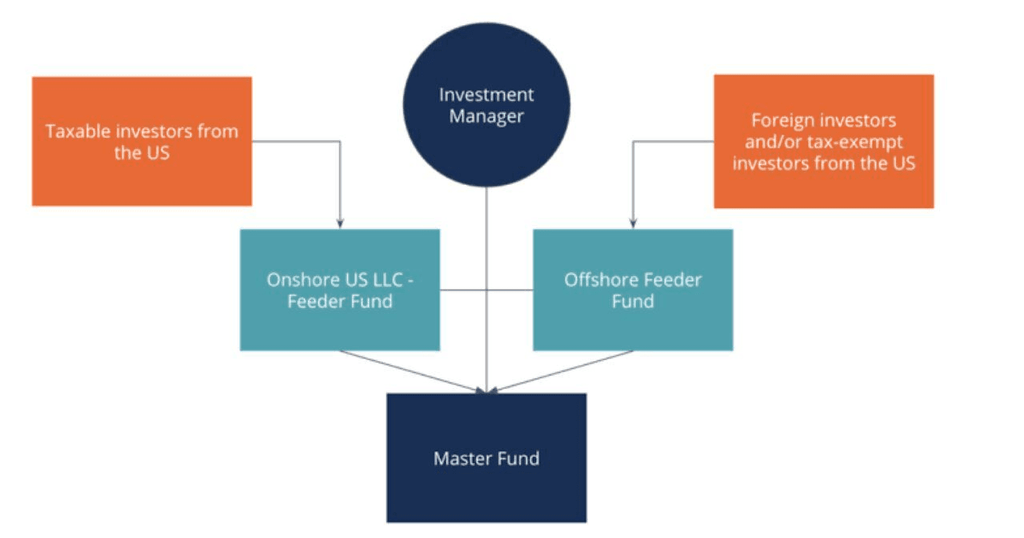
Typical architecture of a multi-currency Master-Feeder investment vehicle. Source: Corporate Finance Institute (other structures exist).
In this type of structure, complexities arise at every stage of the fund's lifecycle:
- The foreign currency Feeder: LPs subscribe through a Feeder denominated in US Dollars (USD).
- The Master Fund in its functional currency: The Master Fund, which makes the actual investments, operates for example in Euros (EUR).
- Cash flow mismatches: When the GP issues capital calls or makes distributions, the difference between the amount stated in EUR and its equivalent in the LP's or Feeder's currency creates residual foreign exchange risk. This risk arises either from exchange rate movements between the initial commitment and the capital call date, or from exchange rate movements between the initial investment and the distribution date.
- Valuation and reporting risk: Converting the NAV from the Master Fund's currency into the Feeder's currency introduces foreign exchange volatility on top of the underlying asset performance, potentially distorting the LP's view of the fund's actual performance.
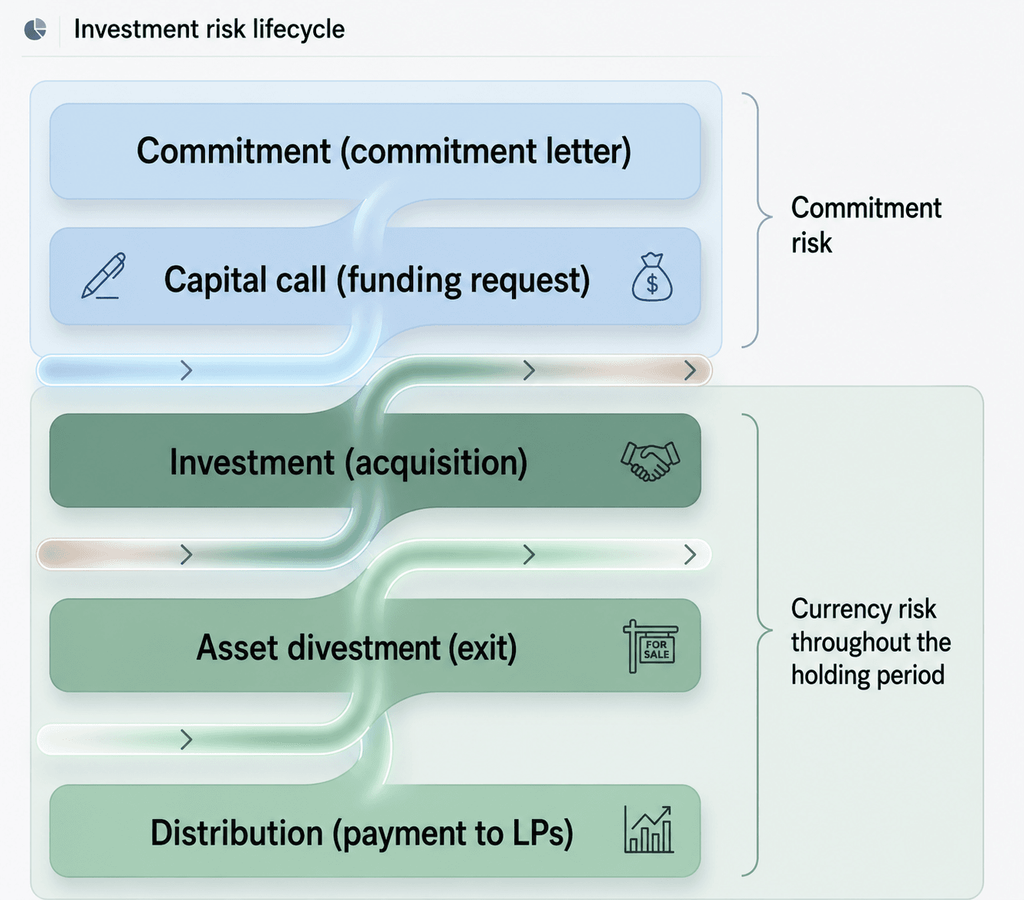
- Commitment risk (or funding risk): When the Feeder signs a commitment letter with the Master Fund in one currency (for example EUR), while the underlying LP has committed in another currency (for example USD), a significant depreciation of the LP's currency may prevent it from meeting its capital calls. If the amount payable in EUR becomes too high versus the initial committed USD notionnal, the LP may no longer be able to fully satisfy the capital call, exposing the Feeder, and therefore the entire structure, to default risk. The consequences can be severe: contractual penalties, dilution, loss of rights (voting, pre-emption, future distributions), or even exclusion from the fund under the default provisions of the LPA. To mitigate this risk, it is essential to implement foreign exchange hedging on uncalled commitments or, alternatively, to maintain an adequate buffer between the spot conversion level and the potential foreign exchange exposure over the entire capital call period, sufficient to absorb adverse exchange rate movements (Value-at-Risk (VaR) calculations using different confidence levels can be particularly useful).
Without a robust hedging protocol for investment funds, LPs investing through the Feeder experience performance (IRR / TVPI) that diverges from that of the Master Fund depending on exchange rate movements. Implementing a hedging strategy does not simply eliminate this difference; rather, it replaces it with exposure to the interest rate differential between the two currencies (covered interest rate parity). In practice, a USD Feeder hedged against a EUR Master Fund effectively bases its return not on EURIBOR but on SOFR, generating either a carry gain or a carry cost depending on the direction and magnitude of the interest rate differential. The GP's objective is therefore not to guarantee mechanical equivalence between the Master and the Feeder, but to make any performance difference predictable and explainable, driven by interest rates rather than erratic foreign exchange volatility.
2. Operational management of capital calls and distributions in foreign currencies
The operational cycle of a Private Equity or private debt fund is not linear. It is driven by intermittent capital flows, making the implementation of a standard FX hedging strategy more complex.
Even before these distributions materialize, risk analysis must be integrated upstream into the investment cycle. Read our article on Market Due Diligence: Why Financial Risk Assessment Is Critical Before an Acquisition..
Managing the timing of capital calls
When a GP identifies an investment opportunity at the Master Fund level (in EUR), it issues a capital call notice to its LPs. Investors generally have a legal period of 10 to 15 business days to fund their commitments.
If the Feeder must convert USD into EUR to fund the Master Fund at the end of this period, it is exposed to the risk that the Euro appreciates during those two weeks, making the investment more expensive than expected in USD terms.
To mitigate this risk, the manager may use short-dated forward contracts as soon as the capital call notice is issued, or rely on subscription lines (bridge financing), which smooth and consolidate funding requirements, thereby reducing the frequency of exposure to foreign exchange risk.
Securing distributions
When a portfolio investment is exited, the Master Fund receives the sale proceeds (generally in EUR or in the asset's local currency). The investment committee then approves the distribution of these proceeds to the LPs. However, foreign exchange exposure is not limited to the short period between the closing of the sale and the receipt of funds by the LP. It actually begins with the initial acquisition of the asset. Any adverse movement in the asset's currency between the investment date and the final distribution reduces the amount ultimately received by the LP in its reference currency, directly impacting the vehicle's DPI (Distributed to Paid-In Capital).
3. Regulatory framework: focus on the SLP and FX authorization
The structuring of these hedging strategies does not solely depend on financial criteria; it is strongly governed by the regulatory and legal frameworks of the countries where the investment vehicles are domiciled (France, Luxembourg, Ireland).
The case of the SLP (Special Limited Partnership)
In Luxembourg or in France through the FPS/SLP, the Special Limited Partnership is the preferred vehicle for alternative investment funds (AIFs). The contractual flexibility of the SLP allows the creation of specific share classes incorporating tailored hedging policies. Gains and losses generated by foreign exchange derivative instruments can therefore be allocated exclusively to the relevant Feeder share class, preventing any performance impact from being transferred to LPs investing directly in the Master Fund’s currency.
The strategic importance of FX authorization
To execute Forex derivative transactions (Forwards, Swaps, Options) at the fund level, the manager must ensure that the vehicle has the appropriate legal documentation in place (ISDA Master Agreement or equivalent local agreement, potentially supplemented by a CSA if banks are unable to grant risk lines) with an authorized financial counterparty. However, the resulting collateral requirements depend on the vehicle’s classification under EMIR (European Market Infrastructure Regulation): an UCITS, classified as a Financial Counterparty (FC), is in principle subject to mandatory Variation Margin exchange, and potentially Initial Margin requirements. Conversely, an AIF structured as an SLP, often classified as a Non-Financial Counterparty below the clearing threshold (NFC-), may be exempt from these margin requirements, while remaining subject to EMIR reporting and risk management obligations. This distinction is strategic for the GP: it directly determines collateral and liquidity requirements, and therefore the operational cost of the hedging program.
4. Technical complexity: from roll-over management to liquidity risk
Implementing a fund-level hedging strategy exposes the GP to technical constraints that go beyond simple uncertainty around the timing of cash flows (investments, disposals). The vehicle’s limited internal liquidity and banking constraints may restrict the available hedging options.
Roll-over management (extension of hedging positions)
Private equity investments typically span long investment horizons (often 5 to 7 years during the holding period), while liquidity and market depth for operational FX forward contracts are concentrated on shorter maturities (generally below 12 or 24 months). Beyond these market constraints, banking limitations also apply: counterparty credit lines allocated to the fund are increasingly consumed as forward maturities extend, and regulatory capital costs (Basel III) make banks reluctant to quote beyond certain maturities. In practice, the GP is therefore often required to build a series of short-term contracts that are periodically renewed (roll-over), introducing additional risks and potentially increasing dependency on a limited number of banking counterparties.
The fund controlling team must therefore implement a roll-over mechanism (periodic renewal of positions). At each forward contract maturity, the position is unwound and extended into the following period through an FX swap. This process generates two types of impacts:
- The impact of swap points: The “cost” or “gain” of the roll depends directly on the interest rate differential between the two currencies, the hedged exposure, and the strategies implemented to manage this risk. As a result, a performance gap may arise between a feeder fund and a master fund, or between a hedged share class and an unhedged share class.
- Extension at historical rate or spot rate: the cash drag risk. If the market moves significantly against the fund’s hedging position, the hedge may show a substantial unrealized loss. An extension at the spot rate results in the unwinding of this position and the realization of the loss, creating a cash outflow that may directly reduce IRR. An extension at the historical rate avoids this immediate cash outflow by incorporating the unrealized loss into the new hedge. However, this solution may become costly over time, particularly due to higher financing and credit charges. Finally, certain funds may be subject to regular margin calls requiring them to mobilize liquidity (UCITS). This cash requirement may lead the manager to maintain non-invested cash reserves, negatively impacting the fund’s overall return: this is the cash drag effect.
For funds or corporate structures subject to financial transparency requirements, integrating derivatives requires precise alignment with international standards. Discover our recommendations for optimizing your IFRS 9 hedge accounting reports.
5. The imperative of transparency: FX reporting for LPs
Managing these complex mechanisms creates a natural information asymmetry between the fund manager (GP) and its investors (LPs). To maintain a relationship of trust and explain the potential gap between the gross asset IRR and the net distributed IRR, highly accurate FX reporting is essential.
Institutional-level foreign exchange reporting must be able to transparently break down the following elements:
- The impact of pure asset performance: The return generated by the operational activity of portfolio investments, excluding currency effects.
- The cost of hedging: The exact amount of option premiums consumed or the impact of swap points incurred during roll-over operations.
- The monitoring of realized cash flows related to Rollovers: Detailed tracking of gains and losses actually settled during roll-over operations (nettings), in order to distinguish cash impacts from simple valuation movements of derivative instruments.
- Mark-to-Market (MtM) impacts: The unrealized valuation of derivative instruments at the fund’s NAV closing date, enabling LPs to understand accounting fluctuations affecting their equity.
- IRR reconciliation: A clear bridge table demonstrating how the hedging strategy helped protect (or adjust) the investor’s final performance indicator compared with the Master Fund vehicle.
Conclusion: Structuring the financial resilience of your vehicles
Fund-level hedging is not merely a technical convenience; it is a set of mechanisms that constitutes a genuine management tool, enabling funds to control the impact of currency volatility on performance while balancing the operational requirements of the manager with investors’ expectations. An effective strategy relies on a balance between controlling hedging costs, managing cash flows, ensuring reporting transparency, and overseeing foreign exchange risk. There is no one-size-fits-all model: each hedging policy must be designed according to the characteristics of the fund, its investment strategy, and the objectives of its LPs. A tailored approach makes it possible to find the right balance between protection against foreign exchange risk, financial performance, and operational efficiency.
Fund-level hedging goes beyond the execution of hedging transactions.
At Kerius Finance, we support alternative fund managers (Private Equity, Debt, Infrastructure, Real Estate) in modelling their exposures, selecting hedging banking infrastructures, and producing transparent reporting dedicated to your investors.
Entrust your FX risk management to an independent partner
Are you launching a new multi-currency vehicle or looking to audit the hedging costs of your existing Feeders? The experts at Kerius Finance provide their institutional expertise to help you design an optimal and transparent hedging strategy. Do not hesitate to contact us to discuss your requirements.
Disclaimer:
Kerius Finance is an independent advisory firm, authorised as a Financial Investment Advisor (CIF) – ORIAS N° 13000716 - Member of ANACOFI-CIF, an association approved by the Autorité des Marchés Financiers (France).
As such, Kerius Finance, which is product and bank-neutral and does not distribute or sell any financial products, only provides personalised recommendations after signing an engagement letter specifying the client's objectives, and carrying out in-depth, personalised analyses.
This document is therefore provided solely for informational and educational purposes. It does not constitute, under any circumstances, a recommendation to enter into any transaction involving the products described herein. The Kerius Finance team remains available to provide further clarification or personalised advice where required.
Please note: banks may offer products that appear identical but contain specific contractual provisions, sometimes subtle, which can significantly affect both the economic outcome and the accounting treatment of the transaction. These products may differ from those presented in this document even when they share the same or a very similar name. Banks may also offer "enhanced" or "dynamic" products, which should be approached with caution and require thorough analysis before implementation.
We recommend in any case that companies which do not have access to an expert treasurer and professional valuation systems seek the support of qualified, regulated advisors to carry out the appropriate analyses, select the right strategy without conflicts of interest, and then negotiate it as effectively as possible (legal terms and pricing) with their usual banking partners. It is also often useful to monitor the strategy over time to ensure that any developments affecting the debt do not require adjustments to the hedging strategy.

OUR TEAM SUPPORTS YOU
Kerius Finance brings together a team of passionate experts dedicated to analyzing, managing, and optimizing financial risks. Our approach is based on transparency, rigor, and attentiveness, enabling us to fully understand your challenges and provide tailored solutions.